Haunted Vampire Font: Spooky Elegance for Handmade Labels & Printables
There’s that moment—right after you’ve poured your third candle of the season—when you hold up the blank label and think, This needs more soul. Not just any soul. A whisper of gothic romance, a flicker of vintage theatre, something with teeth but also tenderness. That’s when I opened my font folder, scrolled past the usual suspects, and landed on Haunted Vampire. Instantly, it felt like finding the perfect velvet ribbon for a black gift box: rich, intentional, quietly dramatic.
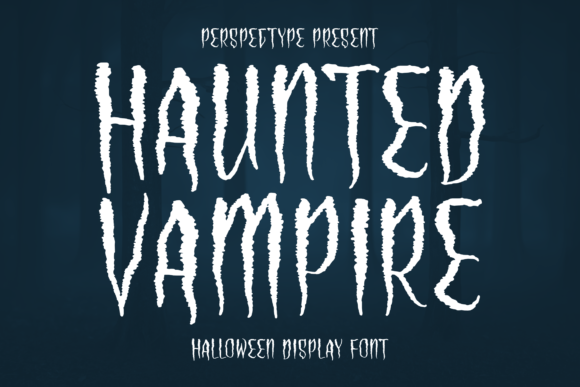
Haunted Vampire is a Script Amp display font from Perspectype Studio—designed not for paragraphs, but for presence. It’s a script font with confident, flowing strokes, subtle contrast in line weight, and just enough ornamental flair (think delicate swashes on capital letters and thoughtful ligatures) to feel hand-drawn—but polished enough for professional packaging. It leans into its Halloween roots without leaning too hard: no cartoon bats or dripping blood here. Instead, it’s moody, romantic, and timeless—like ink from a 19th-century love letter found tucked inside an old apothecary jar.
I first tested Haunted Vampire on candle labels—small 2” x 3” kraft paper stickers. The capitals held up beautifully at 24pt, especially “Midnight Rose” and “Black Currant & Clove.” The lowercase “a,” “g,” and “y” have gentle, open counters that stayed legible even when printed at 18pt on matte sticker stock. For tiny product tags or boutique hang tags, I stuck to short names or scent titles only—never full ingredient lists—and paired them with a clean sans serif (I used Montserrat Light for body text). That contrast gave the brand warmth *and* clarity.
It shines brightest where typography carries emotional weight: greeting cards for October birthdays, printable wedding welcome signs for couples who love Edgar Allan Poe and pressed flowers, planner pages for spooky season journaling, and digital wall art meant to hang above a mantel or in a cozy reading nook. One afternoon, I mocked up a set of printable “Witch’s Brew” tea bag labels—using Haunted Vampire for the flavor name and a soft serif (Cormorant Garamond) for the brewing instructions. The pairing felt intentional, layered, and quietly luxurious—even before printing.
For physical merchandise, I ran quick tests: on ceramic mugs (heat-transfer vinyl), cotton tote bags (screen-printed), and enamel pins (vector-converted). At larger sizes—36pt and up—the swashes sang. At smaller sizes (under 14pt on a shirt tag or 10pt on a sticker sheet), I skipped the most elaborate alternates and used the standard character set. Always check your cutting machine software (Cricut Design Space, Silhouette Studio) for glyph support—Haunted Vampire includes OTF files with full OpenType features, so ligatures and stylistic sets are accessible if your software supports them.
What makes Haunted Vampire especially useful for makers is how well it wears different hats across your shop. Use it as your hero display font—for logo lockups, banner headers, and social media story highlights—and pair it thoughtfully elsewhere. Try it with:
- A minimalist sans serif (like Inter or Poppins) for clean, modern contrast on packaging or digital templates
- A quiet serif (such as Lora or Playfair Display) for invitation suites where elegance meets narrative
- A second, simpler script (like “Lavanderia” or “Maiden Orange”) for layered quotes—Haunted Vampire as the title, the lighter script as the subtitle
It’s not built for long paragraphs or fine print—but that’s exactly why it works so well for handmade product makers. You’re rarely typesetting novels on a soy wax candle label. You’re communicating mood, intention, and care in under five words. “Hand-Poured • Small Batch • Midnight Hour.” Haunted Vampire gives those phrases weight. It tells customers before they even read the description: This was made with attention. This has a point of view.
I also used it for seasonal digital downloads—Halloween-themed quote posters, printable party banners, and SVG cut files for haunted house decor. Because it’s a commercial font licensed for both physical and digital use, I could confidently include it in editable Canva templates and layered PSD files (with proper licensing notes in the description). Just be sure to verify file formats included (OTF + TTF are standard), check for multilingual glyphs if you serve global buyers, and confirm commercial rights cover your specific use case—especially for print-on-demand platforms or SVG-based craft bundles.
One unexpected win? Packaging consistency. When I switched from a generic script to Haunted Vampire across candle labels, shopping bag stamps, and thank-you cards, the whole unboxing experience felt more cohesive—not because everything looked identical, but because the same quiet drama threaded through each piece. Customers didn’t comment on the font by name, but several mentioned how “thoughtful” and “cohesive” the branding felt. That’s the power of intentional typography: it doesn’t shout—it lingers.
If you work with seasonal collections, limited editions, or storytelling-driven products, Haunted Vampire isn’t just decoration. It’s a design asset that deepens atmosphere, supports brand voice, and helps handmade goods stand out on crowded shelves—or in endless scroll feeds. It’s got the kind of charm that invites a second look, the kind of structure that holds up under real-world production, and the kind of soul that makes your shop feel unmistakably yours.
So next time you’re staring at that blank label, that empty card front, or that digital template waiting for its voice—try typing “October,” “Eternal,” or “Velvet Hour” in Haunted Vampire. See how it bends light, holds space, and makes even the simplest phrase feel like a promise.