Kataluna: A Sweet, Natural Handwritten Script Font for Makers
It was a quiet Tuesday morning—coffee steaming, candle wax cooling on my workbench—and I was tweaking the label design for a new lavender-vanilla soy candle. The scent was calming; the design? Not quite right. The clean sans serif felt too clinical. The ornate calligraphy looked fussy and hard to cut on my Cricut. Then I opened Kataluna, typed “Lavender & Light,” and everything softened—just enough.
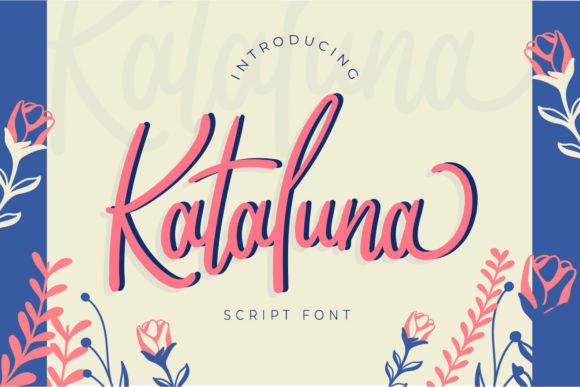
Kataluna is a sweet, natural-looking handwritten script font that breathes gentle warmth into handmade products. It’s not overly looped or dramatic—it flows like ink from a fine-tip pen, with subtle variation in stroke weight and organic spacing. There’s no forced elegance here; just honest, approachable charm. As a script font, it leans modern but never cold, playful but never childish. That balance makes it ideal for makers who want their typography to feel intentional—not decorative for decoration’s sake, but expressive, human, and quietly confident.
I first used Kataluna on a set of kraft paper gift tags for a small-batch soap line. The lowercase “a” and “g” have friendly, open shapes—no tight counters that vanish at 8pt on a tiny tag. When printed at 12pt on matte sticker paper, every curve held its shape. Even when scaled down for jar labels (think 3/4” height), the letterforms stayed legible without losing personality. That’s rare in script fonts—and essential if you’re designing for physical goods like candle jars, tea tins, or boutique packaging.
For greeting cards and wedding stationery, Kataluna shines as a display font. I paired it with a light, airy sans serif (like Montserrat Light) for body text—and suddenly, a simple “Thank You” card felt elevated, cohesive, and personal. No extra embellishments needed. The font’s natural rhythm guides the eye without shouting. On wedding welcome boards or framed planner pages, it adds sincerity—not stiffness. And because it’s designed with real-world use in mind, the baseline alignment is consistent across characters, so lines of text sit cleanly even when layered over watercolor backgrounds or textured digital papers.
As a printable creator, I’ve tested Kataluna across formats: digital wall art previews (it renders beautifully on Etsy listing thumbnails), SVG-ready sticker sheets (clean vector paths, no jagged edges), and editable Canva templates (works flawlessly in web-based editors). For seasonal products—think holiday tags, spring shower invitations, or autumn market banners—it adds seasonal softness without leaning into cliché. A “Merry & Bright” banner in Kataluna feels joyful but grounded. A “Hello, Spring” tote bag design feels fresh, not frantic.
Readability matters—especially when your font ends up on a mug, shirt, or vinyl decal. Kataluna isn’t built for paragraphs. It’s a display font: best for names, titles, short phrases, and decorative wording. I avoid using it for full invitation copy or ingredient lists—but love it for “Est. 2023,” “Hand-poured in Oregon,” or “With Love, Sarah.” For longer text, I always pair it thoughtfully: a simple serif (like Playfair Display) for elegance, or a neutral sans (like Lato or Inter) for contrast and clarity. That pairing creates visual hierarchy—and tells customers, without saying a word, that your brand values both heart and craft.
Before adding Kataluna to any product—whether it’s a physical candle label, an editable PDF planner, or a Silhouette-compatible SVG file—I double-check the included files. The Script Amp version includes OTF and TTF formats, plus OpenType features like standard ligatures and contextual alternates. Those little extras let me swap in a prettier “&” or adjust the tail on a final “y” for better flow. I also verify commercial licensing—yes, Kataluna is cleared for use in physical products, digital downloads, and merchandise, as long as it’s embedded or converted properly (never distributed as raw font files).
On mugs and shirts, I test print proofs at actual size. Kataluna’s generous x-height and open counters hold up well in screen printing and sublimation—no thin strokes disappearing mid-bake. For Cricut and Silhouette users: it cuts cleanly at 18pt and above. Below that, I simplify—using only the most distinct letters (like “S,” “O,” “L”) for tiny sticker accents or charm labels. And for social media graphics? It adds instant warmth to Instagram story highlights or Pinterest pins—without competing with your product photo.
What surprises me most about Kataluna is how consistently it supports brand voice. Whether I’m designing minimalist farmhouse signs (“Gather Here”), elegant wedding menus, or cheerful kids’ birthday invites, the font adapts—never overpowering, always enhancing. It doesn’t demand attention; it earns it, softly. That’s why it’s become my go-to script font for shop branding elements: logo lockups, website headers, email banners, even the “handmade with care” note tucked inside packaging.
If you're choosing a script font for your next batch of handmade goods, ask yourself: Does it feel like *you*? Does it stay true at small sizes? Does it pair easily with other typefaces you already love? Does it come with reliable licensing and clean file formats? Kataluna answers yes—to all of them. It’s not flashy. It’s not trying to be the loudest voice in the room. But when your lavender candle sits beside five others on a shelf—or your printable wall art appears in someone’s cozy corner—it’s the quiet confidence of Kataluna that makes people pause, smile, and reach out.
That’s the power of thoughtful typography: not just letters on a page, but warmth made visible. And with Kataluna, that warmth starts right where your hand meets the design.