Alif Baa Taa Pen: A Handwritten Arabic Font for Crafters & Sellers
If you design printable Arabic worksheets, craft bilingual wedding stationery, or create hand-stamped tags for olive oil bottles sold at local markets—you’ll instantly recognize the quiet magic of Alif Baa Taa Pen. This isn’t just another script font. It’s a thoughtful, warm, and intentionally legible handwritten Arabic typeface built for real-world making—not just classroom drills. As a small shop owner who ships custom-printed tea towels, boutique gift tags, and Cricut-cut wall art to customers across three continents, I’ve tested dozens of Arabic fonts. Alif Baa Taa Pen stands out because it balances authenticity with usability—no awkward spacing, no clipped diacritics, and no guesswork when scaling down for ¾-inch sticker labels.
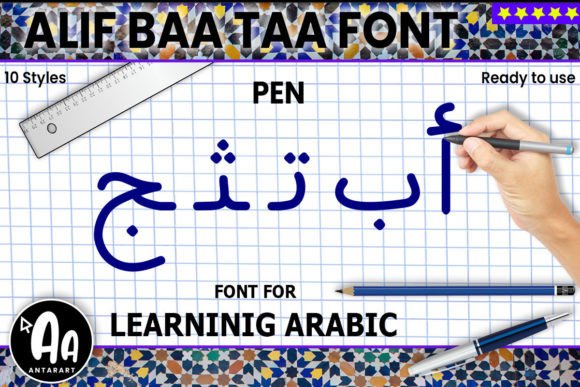
Visually, Alif Baa Taa Pen feels like ink freshly drawn with a fine nib—slightly rounded, gently modulated, with natural variation in stroke weight that breathes life into each letter. It’s not overly ornate, nor is it stripped bare. That sweet spot makes it perfect for display use: think “Welcome” on a farmhouse-style welcome board at an Eid open house, or “Bismillah” elegantly arched above a printable Ramadan planner cover. The letters connect smoothly where they should—and pause gracefully where they need to—so even short phrases like “Barakah” or “Yalla!” carry warmth and intention.
I use Alif Baa Taa Pen across six core product categories—and each time, it lifts perceived quality. For handmade candle labels, I pair it with a clean sans serif (like Montserrat or Poppins) for ingredient lists, letting Alif Baa Taa Pen hold the scent name—“Narjis,” “Za’atar,” or “Qahwa”—in elegant, readable script. On cotton tote bags printed with screen-printed Arabic calligraphy, it holds up beautifully at 120 pt without pixelation. And for digital downloads—like my best-selling Arabic baby milestone cards—I layer it over soft watercolor textures, knowing its consistent baseline and open counters keep text crisp even when exported as low-res PNGs for social previews.
Readability matters—especially when cutting. If you’re using Silhouette Studio or Cricut Design Space, test Alif Baa Taa Pen at 18–24 pt before sending to your machine. Its generous x-height and clear letterforms cut cleanly on vinyl, cardstock, and heat-transfer foil—even at 1.25 inches tall. I’ve used it for tiny gold-foiled gift tags (1.5 × 1.5”) with no issues, and for large-format outdoor signs (36” wide) where subtle stroke variation adds texture without sacrificing clarity. Just avoid cramming full sentences into tight spaces—this is a display font first, not a body text workhorse. Stick to names, titles, blessings, short greetings, and decorative phrases.
Pairing is intuitive. When designing bilingual wedding invitations, I set the Arabic couple’s names in Alif Baa Taa Pen and the English names in a refined serif like Playfair Display—creating harmony without competition. For product packaging—say, artisanal spice tins—I combine it with a friendly geometric sans (like Nunito or Quicksand) for net weight, origin, and usage tips. That contrast says “handmade with care” while staying shelf-ready and scannable. No ligature overload or distracting swashes here—Alif Baa Taa Pen includes standard OpenType features common in Script Amp fonts, but keeps focus on clarity over flourish. It supports full Arabic script—including initial, medial, final, and isolated forms—so your “Salam” or “Shukran” renders correctly every time, whether typed in Word, Canva, or Adobe Illustrator.
Commercial use? Yes—fully licensed. As a seller of printable Arabic planners, SVG files for cutting machines, and physical goods like engraved wooden spoons with Arabic proverbs, I double-checked: Alif Baa Taa Pen permits use in both physical products and digital downloads, including resale of templates, client projects, and merchandise. That peace of mind matters—no last-minute font swaps before launching a new Etsy collection. Just install, design, and ship.
Real examples from my shop: a set of 12 printable “Ramadan Nights” wall quotes (all in Alif Baa Taa Pen + subtle gold foil overlay), a series of laser-cut acrylic keychains with “Habibi” and “Ya Qalbi” etched in clean vector outlines, and a line of organic cotton tea towels featuring “Qahwa & Qalb” in soft navy embroidery—digitized directly from the font’s vector outlines. Customers consistently comment on how “genuine” and “inviting” the Arabic text feels—not stiff, not robotic, not like a textbook. That emotional resonance sells.
It also works beautifully in seasonal collections. Last Eid, I launched a matching set of greeting cards and gift tags with “Eid Mubarak” in Alif Baa Taa Pen, paired with hand-drawn crescent motifs. The font’s gentle rhythm made the phrase feel personal—not generic. Same for back-to-school printable bundles: “Madinah Notebook Covers” and “Quran Journal Pages” all rely on its calm authority. Even for packaging—think kraft boxes stamped with “Min al-Qahira” or “Made with Barakah”—it conveys heritage without cliché.
One practical note: always preview your text at actual print size before finalizing. Alif Baa Taa Pen shines brightest when given room to breathe—so avoid tight kerning on small labels, and don’t stretch or skew the font. Let its natural flow do the work. And if you're bundling it into a commercial template pack (e.g., “Arabic Wedding Bundle for Canva”), include a quick license reminder in your PDF guide—your buyers will appreciate the transparency.
Whether you’re sketching ideas in Procreate, prepping files for DTG printing, or cutting intricate vinyl decals for a pop-up bazaar stall—Alif Baa Taa Pen delivers. It’s not flashy. It doesn’t try too hard. But it shows up—consistently, gracefully, and ready to make your Arabic text feel human, intentional, and deeply rooted in craft.