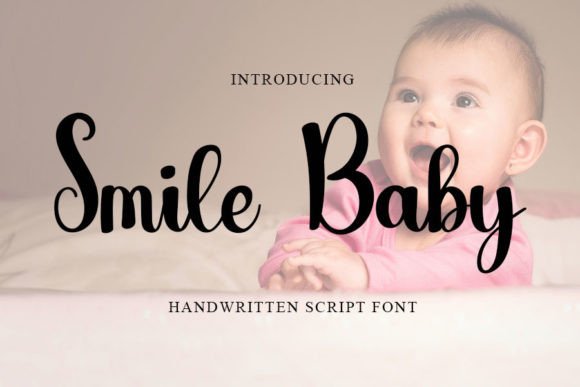
Smile Baby Handwritten Font for Crafters & Sellers
If you’ve ever stared at a blank label, sticker sheet, or printable template wondering how to make it feel warm, approachable, and unmistakably *yours*, Smile Baby is the handwritten font that answers that quiet creative need. It’s not just another script—it’s a friendly nudge in type form. Designed with soft curves, gentle pressure variation, and a relaxed rhythm, Smile Baby lands somewhere between joyful penmanship and polished professionalism. As someone who hand-labels small-batch candles, designs wedding welcome boards for local venues, and creates digital planner pages sold on Etsy, I reach for Smile Baby when I need personality without sacrificing clarity.
What makes Smile Baby especially useful for physical product makers is its intentional balance: it reads beautifully at 12pt on a kraft paper tag, holds up crisply when cut on a Cricut Maker at 0.75", and still shines large on a farmhouse-style wooden sign. Unlike some overly ornate script fonts, Smile Baby avoids tight loops or fragile terminals—so your vinyl decals won’t snag, your iron-on transfers won’t blur, and your printed invitations won’t look muddy at smaller sizes. It’s a display font that *works*, not just decorates.
I use Smile Baby across my entire product line—no exaggeration. For candle labels, I pair “Lavender Dream” in Smile Baby with a clean sans serif like Montserrat for scent notes and ingredients. On greeting cards, I set the salutation (“Hey there, friend!”) in Smile Baby and keep the body copy in a light-weight serif for readability. Wedding stationery? Smile Baby anchors the couple’s names on save-the-dates and place cards, while subtle alternates (like the lowercase “g” with its looping tail) add quiet charm without overwhelming guests. Even seasonal items—think holiday mugs, Easter egg tags, or summer market tote bags—gain instant warmth when stamped or printed in Smile Baby.
Readability matters most where craft meets commerce. On 1" round stickers for bath bombs, Smile Baby stays legible down to 8pt when printed sharp and vector-cut cleanly. For SVG files used in Silhouette Studio, I always convert Smile Baby to outlines before saving—this preserves spacing and prevents rendering hiccups during cutting. And because Smile Baby includes standard OpenType features like contextual alternates and discretionary ligatures, I can easily swap in a prettier “&” or a flowing “to” without manual tweaking. Bonus: it supports basic Latin multilingual characters—enough to handle common accents for French, Spanish, and German phrases on boutique packaging.
Font pairing is where Smile Baby truly shines in production. As a Script Amp font, it’s built to complement—not compete. My go-to pairing is Smile Baby + a neutral sans serif like Poppins or Inter. The contrast gives structure to handmade charm: Smile Baby carries the emotion, the sans serif delivers information. For vintage-inspired product tags, I’ll layer it over a low-contrast serif like Playfair Display—soft but grounded. Never pair Smile Baby with another expressive script; it loses its voice. And avoid ultra-thin or condensed fonts beneath it—they clash in weight and intention.
Commercial use is non-negotiable for anyone selling physical goods or digital downloads—and Smile Baby delivers. Its license covers unlimited personal *and* commercial use: printables, SVG bundles, client branding projects, merchandise (mugs, tees, totes), physical product labels, and even templates sold on Creative Market or Gumroad. That means when you design a “Baby’s First Christmas” wall art printable or a “Thank You for Supporting Local” sticker pack, Smile Baby is legally covered—no extra fees, no usage caps. Just real peace of mind while scaling your shop.
It’s also worth noting what Smile Baby isn’t—and why that matters. It’s not a full paragraph font. Don’t set a three-paragraph product description in it. It’s not a monoline script, so it won’t mimic a marker or brush pen if that’s your aesthetic goal. And it doesn’t include bold or italic weights—its strength is in its single, thoughtfully drawn style. That simplicity is actually a benefit: fewer files to manage, consistent output across platforms, and faster load times when embedding in Canva templates or web-based mockup tools.
In day-to-day making, Smile Baby saves time and builds trust. Customers recognize warmth and care in typography—even if they can’t name why. A jar of honey labeled with Smile Baby feels more artisanal than one in generic Arial. A baby shower invitation set in Smile Baby signals attention to detail before the guest even opens the envelope. And yes—it converts. On my own Etsy listings, products featuring Smile Baby in their main mockup consistently see higher click-throughs and longer dwell time. Not magic—just thoughtful, human-centered typography doing its job.
Whether you’re laser-cutting wooden gift tags, designing Instagram story templates for fellow sellers, prepping SVG files for sublimation mugs, or laying out a printable budget planner, Smile Baby fits seamlessly into your workflow. It installs like any other font (OTF/TTF), works in Adobe Suite, Cricut Design Space, Silhouette Studio, Canva, and Affinity apps—and renders cleanly whether you’re exporting to PDF, PNG, or SVG. No hidden quirks, no missing glyphs, no licensing guesswork.
At its core, Smile Baby is a tool that respects both your craft and your customers’ experience. It doesn’t shout. It smiles—genuinely, consistently, and commercially. And in a marketplace crowded with loud trends and fleeting aesthetics, that kind of quiet confidence is exactly what handmade brands need to stand out, scale thoughtfully, and keep creating with joy.